Tuesday, April 26, 2016

Masika

Most of the time, weather in Tanzania is pretty much how you would expect equatorial Africa to be: hot.  But each year, we get two seasons of rain.

The first, masika, is the long rains which traditionally take up the months of March, April, May, and June.  The second, mvuli, is the short rains, occurring in October and November.  Of course, with the advent of El Nino and global warming, these dates have become approximate, but you get the general idea.

This schedule puts us smack-dab in the middle of masika, which can be looked at as Tanzania's "winter" season.  It's true the temperature has cooled significantly, but more than that, it's rain rain rain, all day every day.

The house is drafty and damp, laundry never dries, toes and fingers tingle with cold, and I wear a scarf that becomes a crucial part of every outfit, including pajamas.

Work suffers too.  Kids are kept home from school due to the torrents, classrooms are wet and muddy, streets are impassable, cars undrivable.

This week, Hyasinta and I had planned to conduct parent interviews at one of the new sites, Msandaka Primary School, the smallest and most remote of the four schools in which we are now currently operating.

We had just passed by on Friday, another rainy day, and my little '96 Suzuki - true to form - got stuck on a mud bank.  Not wishing a repeat scenario, we decided to leave the car at Msaranga Primary, which is always our home base, and head to Msandaka on foot.

Msandaka is a bit far, it's true, maybe two or three miles, although I am a natural walker, and so enjoy the exercise, but mungu wangu (My God), yesterday was a whole other story.

The road was pure mud, you could barely feel anything solid under your feet at all, and we slipped and slid all over the place, picking our way over rocks, sometimes just giving in and wading through, about two miles deep into the village.  Our other sites are all fairly close to the tarmac road, but Msandaka is definitely well off-the-grid - I know where I'll go when I never want to be found, that's for sure! - and it was a veritable trek with the addition of the quicksand-like mud.

Hyasinta was our fearless leader, picking out the way ahead with me and Teacher Rose C. trailing behind.


Along the sides of the road, men worked in the shambas (farms), one of the boons of such bountiful rains.


The lushness of the village was definitely underscored by the wet conditions.


Certain points along the way were reminiscent of a horror movie.  Dark and angry skies above signposts claiming "No Way Through."


And my Converse All-Stars will never be the same.


But I do love a good adventure, and following Hyasinta through Msaranga was a bittersweet reminder of my days as a wee volunteer, traipsing after Vumi with kids in tow and greeting villagers along the way.

Since we have to go back tomorrow, I think I'll wear my hiking boots, and give the kicks a rest....!

Monday, April 18, 2016

By the Book


I have written about the new Minister of Education, Joyce Ndalichako, on this blog before (http://toanafasi.blogspot.com/2016/01/dear-joyce.html), and now she is making headlines again.  A recent article in the Daily News describes her desire to inculcate and nurture a culture of reading amongst Tanzanian youth.

According to the piece's heading: "The availability of locally relevant Kiswahili readers and English novels, written especially with Tanzanian youth in mind, will encourage Tanzanian students to improve their literacy and language skills.  This, in turn, will contribute to their success on their secondary school examinations, their future studies, and their full participation in society."

A tall order, but a tasty one.  Smacks a bit of Toa Nafasi in the "assessment of primary schoolchildren as an opportunity to determine whether they are developing crucial foundational skills" arena, eh?

Read on below….

####

The Minister for Education, Science, and Vocational Training, Professor Joyce Ndalichako, has appealed to students in the country to nurture their love of reading, not only because it's a hobby, but also because it is useful to read for education, for wider knowledge, and to open new horizons and opportunities.


"Reading is a gift that has been given to you by your teachers.  Treasure it, for it will be the key to future success," Prof. Ndalichako told pupils from Maktaba and Chang'ombe Primary Schools and students from Chang'ombe Secondary School during the Children's Book Project 25th Anniversary which took place in Dar es Salaam recently.

Ms. Sarah Mlaki who read the speech on behalf of the minister, also launched the Mbinu Saba guide, an evaluation report supported by CODE and the government of Canada and Round Six set of books published with the support of the Burt Award for African Literature in Tanzania.  She also presented awards to the winners of Round Seven.

"In this case, I would like to appreciate Children's Book Project (CBP) for Tanzania's contributions to the improvement of the quality of education through provision of learning materials and and training of teachers using Mbinu Saba and for providing results of the comprehensive assessment on the readership program.

I look forward to the Mbinu Saba guide to be distributed to as many teachers as possible through NGOs' support and donors, and BAAL publications of this year to be distributed to as many schools as possible across the country."

Assessment of students' learning in primary grades offers an opportunity to determine whether children are developing the foundational skills upon which all other literacy skills are built and where the efforts need to be directed.

This is vital information for improving the quality of education in schools.  The CBP 25th Anniversary celebration recognized the critical importance of literacy as a tool for learning.  Literacy is vital for individuals and also for the development of the community and the country.

Tanzania has agreed that illiteracy and gender disparities in education need to be addressed.  "Through the 'Education for All' act, we have committed to increase literacy rates by 50 percent by 2025, and through the Millennium Development Goals (MDGs), the government has committed to eliminate gender disparities at all levels of education by 2025," Prof. Ndalichako noted.

There are specific initiatives that are dedicated to helping girls and boys to develop not just basic literacy, but an active love of reading that will last their entire lives.  In 2013, the government unveiled the Big Results Now (BRN) initiatives as a way to fast-track the path from a low to middle-income country.

As one of the six focal areas, the education sector has received much attention, especially in the early primary grades.  Education was deemed as one of the priority sectors in the BRN initiatives, specifically for addressing the disparity between improved school access and declining school quality.

"I would like to pay tribute to those who work behind the scenes - teachers, publishers, writers, and many other hard-working individuals who help others acquire literacy skills.  Their work enables people to access a world of opportunities," she further said.  The minister congratulated teachers, librarians in particular, for their tireless efforts to pass on the precious skill of literacy to Tanzanian children and youth.

Teachers have an enormous responsibility and opportunity to help these young girls and boys develop skills that will enable them to gain access to information, to analyze it, and to make decisions about their futures.

On her part, Executive Secretary of the Children's Book Project, Ms. Pili Dumea, said they have prepared 320 copies of books, six of which are written in English.  According to her, the books were published early January this year, and they plan to publish another five books shortly.

They also prepared a lot of Swahili books to reach many children who prefer to read in their mother tongue.  "CBP has produced around 5,000 books, sold 3,000, and others have been sold in the common market."

"At the beginning of this project, we started with six primary schools in each district," Ms Dumea said, and now they can reach 200 primary schools and five teacher colleges from the Eastern and Central Regions as well as the library communities in Turiani, Mkuranga, and Rufiji districts.  Most of these schools are in Dar es Salaam, Coast Region, Dodoma, and Morogoro.

In the program of study, 5,050 teachers were trained in new methods of teaching children to read and write.  In 2012 and 2013, CBP, in collaboration with CODE Reading Specialists, Prof. Alison Preece and Prof. Charlie Temple, conducted three training workshops in Mlandizi for fifty potential trainers.  Shortly after the last workshop, the CODE Reading Specialists prepared a Mbinu Saba guidebook that supported the teaching methodologies shared in the workshops.

Speaking while making presentation of the Mbinu Saba guidebook, Mr. Marcus Mbigili noted that the guidebook was also intended to remind teachers on the steps to the methodologies introduced in the workshops.

CBP translated the English version into Kiswahili and worked on it to fit the Tanzanian context.  The guidebook contains seven general areas, which include introducing students to Literacy, Phonological Awareness, Phonics, Reading Fluency, Comprehension, Vocabulary, and Writing.

"These seven areas of skill development contain the five that are currently being stressed by the different organizations and programs in Tanzania.  In order to teach reading well, teachers should learn a number of concepts and strategies under these seven general areas," Mr. Mbigili noted.

The Children's Book Project for Tanzania started in 1991 in response to Tanzania's acute shortage of books for children and lack of adequate skills among education sector personnel to produce these reading materials.

CBP set out to assist with the production and distribution of relevant reading materials and to encourage and support indigenous authorship.  Children's Book Project for Tanzania was founded by the Canadian organization CODE in response to the urgent need of books for school-aged children in Tanzania.

The Children's Book Project for Tanzania does not only receive support from CODE, but also from other organizations including SIDA, DANIDA, HIVOS, the International Reading Association, the Canada Fund, and Aga Khan Foundation as well as the government of the Netherlands and the British Council.  Individual projects are funded by various banks in Tanzania.

Sunday, April 17, 2016

Sovereign Sons

From a recent article in the Tanzania Daily News, check out the latest on relations between the United Republic of Tanzania and the United States of America.

####

The Minister of Foreign Affairs, East Africa, Regional and International Cooperation, Dr. Augustine Mahiga, yesterday met with the United States Ambassador to Tanzania, Mr. Mark Childress and discussed bilateral issues among other important matters.

According to a statement from the ministry, during the meeting, they discussed an ongoing partnership including shared goals and continuing U.S. assistance to improve the health and education of Tanzanian people.

Ambassador Childress, who was accompanied by senior teams, spoke on promoting broad-based economic growth and advancing regional security in the spirit of continuing partnership and friendship between the two countries.

According to the U.S. Department of State fact sheet, the U.S. and Tanzania have shared a deep partnership characterized by mutual respect and interest, shared values and aspirations for a more peaceful and prosperous future.

The United States respects Tanzania's record of democratic progress, which has made it a model for the region and beyond and supports Tanzania's continuing efforts to strengthen the institutions of democracy.

The United States is committed to working with Tanzania on nutrition and food security, energy, women's and children's health, HIV/AIDS, and sustainable development, according to the fact sheet updated in August, last year.

The U.S. has provided assistance to Tanzania for development and capacity-building to promote transparency, address health and education issues, and target development indicators to sustain progress.

The U.S. Agency for International Development has provided funding to improve public health and quality of basic education, biodiversity conservation and natural resource management.

Feed the Future has provided funding to boost agricultural growth and productivity, promote market development and trade expansion along with equitable rural economic growth, invest in global innovation, and research and address mother and child malnutrition.

Tuesday, April 12, 2016

Cat Power

WARNING: This blog entry has NOTHING to do with The Toa Nafasi Project.  AND, the post's title is an indicator of both my age and weird musical proclivities.  BUT, that doesn't mean it doesn't have interesting and original content, so please, DO keep reading....

Pretty much everybody who knows me knows that I am the archetypal "crazy cat lady," a badge I wear proudly and without discomfiture - although some of my friends might wish I showed a little more discretion when it comes to my feline fondness.

I have always loved animals and, growing up, I was St. Francis of Rosenbloomington, our family home witness to the comings and goings of various gerbils, goldfish, hamsters (I especially remember one lil' fella named Snoopy; even my dad shed tears when that critter passed on into the great Hamster Heaven), and of course, cats.

So, this blog entry is dedicated to my new bestie, Drogo, the most adorable kitten this side of the Equator.

Now, I know what some of you are saying: There she goes again, the crazy cat lady....  But come on, Droges is part of my life now, and y'all better be happy about that because he's totally keeping me sane!  Not to mention, well-snuggled!!

Last week, I took Drogey to the vet for his second appointment since he entered my life and I thought, even if this blog post isn't about Toa, it IS about life in Tanzania, and one thing I can tell you for sure, is that going to see the veterinarians at Makoa Farm is VERY different than taking those spoiled New York creatures to West Village Vet.

For one thing, instead of sitting calmly and quietly in his box, Drogo insisted on riding up front with me.  This proved to be distracting not only to the driver (myself), but also to the many traffic police who randomly stopped the car for inspection.  Note: it is NOT allowed to wear sandals while driving in Tanzania, but operating a motor vehicle with a cat on your lap is totes cool.
 

Then, there was the actual trek out to the farm which is about half an hour outside of Moshi in a place called Machame.  Thank the good Lord it was not raining on the day of Dro's appointment, or we would have been in serious troubs.  My car is notorious for breakdowns of every sort, but ESPECIALLY in the rainy season, my tiny toy Suzuki likes to crump out in the mud.

The main road from Moshi to Machame is tarmac but the rest of the way to the farm is mud, dirt, dust, and rocks.  Uphill.  So, the threats were various and many: armed police officers on the paved road doing the slow, scary circle around the car; or Mother Nature and her assorted perils.


When you first arrive at Makoa Farm, you are greeted by this character I call the "flat chicken."  I have no idea how he came to look like this, but the vets, a German couple named Laszlo and Elizabeth, call him "Asterix."  Word to the wise, he WILL peck your toes off.


Other fine, feathered friends abound at Makoa including a pair of geese and this ginormous vulture-y thing that made both Drogo and me a little nervous.


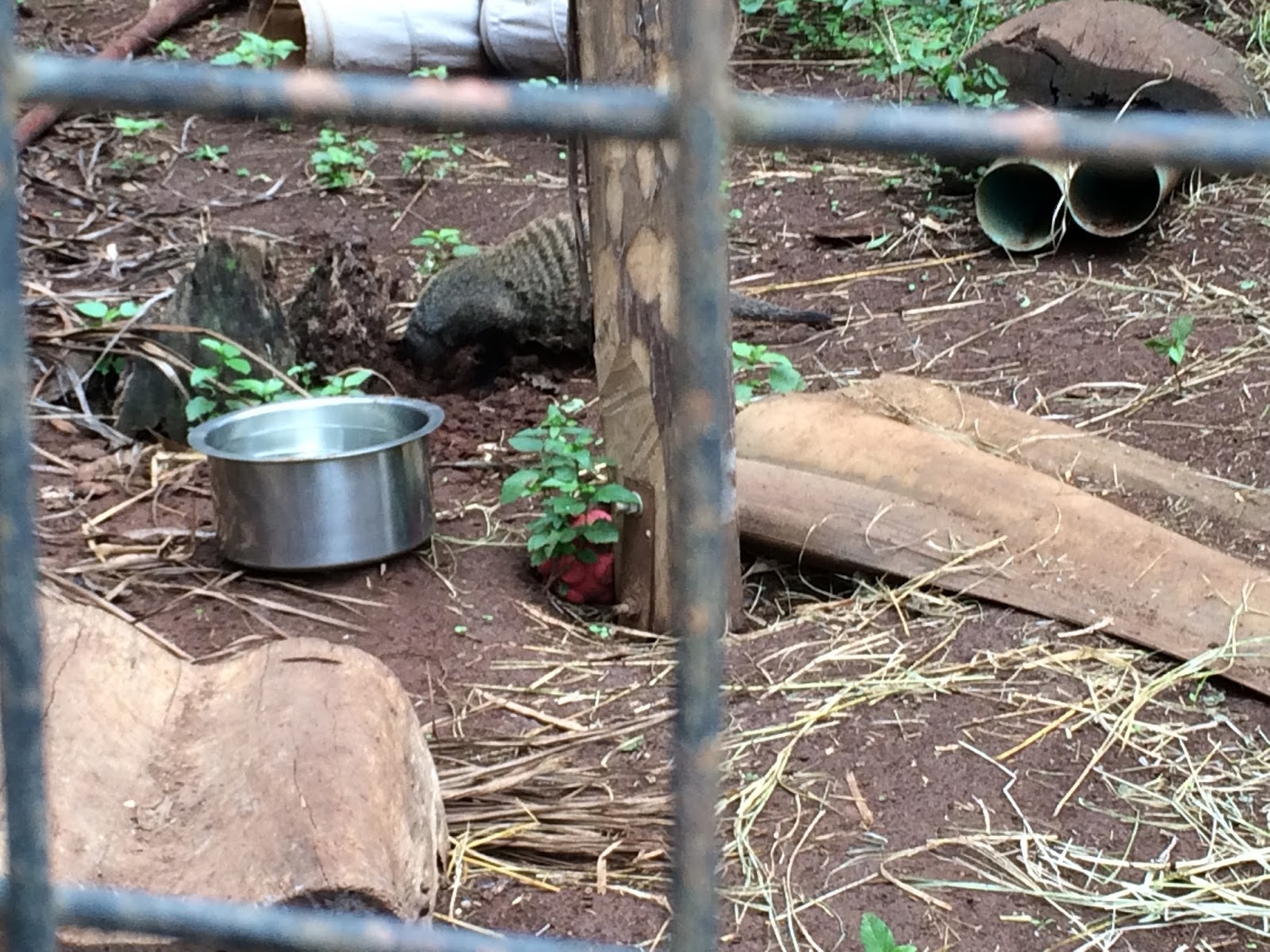
There's also a bunny hutch, a couple of mongoose (mongeese??), and a wise old monkey.


Laszlo and Elizabeth used to care for an injured cheetah, and Drogo and I met him on our first visit, but I found out this last time, that he just recently died of a cobra bite!  Made me very sad actually, as they had completely rehabilitated the animal, but due to some bureaucratic red tape from the national parks people, his release back into the wild was delayed.  Thus, he died in captivity from deadly snake venom.

Additionally, they just recently came into possession of a baby elephant whose mama was killed by poachers and was not expected to live.  This, I was told later, as it appears I totally missed the "elephant in the room" though I was standing perhaps ten feet away from him.  At least, prognosis is good for young Babar and hopefully when Dr. Dro and I go for our third visit, we'll get to peep the little guy.

At any rate, Drogo got his second round of vaccinations and I am so grateful to Laszlo and Elizabeth for their good care of him and all the other household pets in and around Moshi who can count on proper veterinary care in Tanzania.

Typically, Tanzanians are not much for animals: dogs are security hounds only and are generally treated quite cruelly; cats are simply pestilence.  It's nice to be able to find someone to help care for and treat our animals the way we would at home.  Even if it's about ten thousand miles and a few monkeys away from West Village Vet!


There now, you've reached the end of the "crazy cat lady" blog post.  It wasn't so bad, was it?!  Promise I won't let my cat fancy side out again, at least until Dro gets neutered; that should make for some good reading....

Tuesday, April 5, 2016

Usonji Day 2.0

Greetings from cold and rainy Moshi, Kilimanjaro!  Spring has sprung, and with it, come the rains.... finally!!  We are happy to, at last, have some relief from the intense heat that has plagued us all year, but at the same time, rain brings other troubles: cold and wet, mud and dirt, stuck cars and no power.  Nevertheless, I have been told not to complain, that mvua ni baraka (rain is a blessing), so I guess I should just count it, and be done!

This past Saturday, we celebrated once again Siku ya Usonji Duniani (World Autism Day) with a march through downtown Moshi and festivities at the Gabriella Center, which is always a big contributor to the event for obvious reasons.  In case you don't remember, we participated in the big day last year though not as actively as I would have liked, so this year I made a concerted effort to get Toa Nafasi into the mix properly.  Under the umbrella of Connects Autism Tanzania, another local NGO dealing more specifically with autism than us, we were able to join in.  Check last year's blog post here: http://toanafasi.blogspot.com/2015/04/usonji-day_16.html


We had a banner made with the "Light It Up Blue" theme for autism and arranged for all staff to wear their Toa Nafasi t-shirts.  Nearly all of our wonderful teachers made the trek from Msaranga into town, and even the diwani (local councilman) came to represent.


After an abbreviated walk (RAIN!), we ended up at the Hindu Stadium for some speeches and a bit of drumming and dancing.  In the last photo below, the kid in the middle with his head bent in concentration is one of the students that Toa Nafasi sponsors to board and study at Gabriella.  He is definitely somewhere on the autism spectrum, but doing remarkably well at Gabriella and showing an amazing proclivity for drumming, something we never would have known had he stayed at Msaranga Primary!  So proud of Danny!!


After the speeches and drums, the event was more or less over and the rains had started to come down in earnest.  But, our day was not yet done.  I had decided that because Toa Nafasi and Gabriella have developed such an incredible partnership, I would co-sponsor a lunch at the center for the kids, their parents, our teachers, and assorted guests and speakers.  Well, this was a GREAT idea when we were planning it but when the time came to go, it was raining buckets of cold, wet, sloppy drops and I was wearing open-toed sandals and short sleeves.  The mud was epic and the whole thing was a bit of a mess as the special guest scheduled to talk (some government bigwig) was two hours late and no one had eaten lunch!  Now, looking back, of course I'm glad we stuck with it, but it was a bit uncomfortable at the time!!  (And my car only got stuck in the mud once, soooo....)


All in all, I'd have to say it was a pretty great day and I am happy that Toa Nafasi was able to be a part of it.  I think the teachers felt a bit special, that their work in a dusty little classroom in Msaranga is actually part of a bigger system and has a meaning beyond passing the hours and banking a paycheck.  I had hoped for a bit more networking at Gabriella but the rain made it impossible.  Plus, it's always good to have something more to strive for next year!  Light it up blue!!

PS: The photos taken for this blog entry are by Marytza Leiva.  Asante sana, Marytza!

Friday, March 25, 2016

"I've Named Her Scholastica"

Please take a moment to check out this magnificent photo-journalistic look at Tanzanian teen mothers and their children from Vice Media's new(ish) feminist channel, Broadly.  The author, Rebecca Schiller, is CEO of human rights in childbirth charity, Birthrights, and writes about reproductive rights, parenting, and birth.

I realize it is only tangentially related to the activities of The Toa Nafasi Project, but sex education is education nonetheless and our girls with intellectual impairment are even more at risk than typically developed young ladies.

In addition, the photographs are stunning and it is worth even just a cursory glance: https://broadly.vice.com/en_us/article/ive-named-her-scholastica-photos-of-tanzanias-teen-mothers-and-their-babies.

####

In Tanzania, girls are traditionally married off before they are 18.  In childbirth, they routinely lack access to life-saving cesareans and medical treatment.  Despite this, young women are daring to dream for more.

Eva Paulo wanted to be a tailor when she grew up.  When I meet her, she is dressed in a floor-length pink gown - the kind of dress teenagers wear to prom, with a ruffle that trails behind her in the dust.  She made it herself; it acts as a silky reminder of what she has lost.  Like many young women in rural areas of Tanzania, the 17-year-old's greatest ambition is now survival.
 
 
Married at 14, de facto divorced three years later, Paulo is a single mother to a three-month-old baby.  Her husband rejected her, so she now relies on an uncle for food and shelter.  She has achieved a lot since then, not least surviving childbirth, the leading global cause of death for young women aged 15 to 19.  She's lucky to live near to Uteshu, where Africa's leading health charity Amref Health Africa have overhauled the facilities to ensure women have access to life-saving cesareans, antenatal care and HIV clinics.

Paulo is the only woman I meet during a week travelling across the Shinyanga region of Tanzania who cries while telling me her story.  The unfairness of her abandonment is too much for her.  "Don't cry, don't cry," says our translator.  I don't hush her; she seems glad of the permission to talk.  "It's not that I want my husband to come back," she explains, "I don't.  But it is difficult to be on your own.  Raising a baby in this environment, in these conditions, is tough for anyone."

Though practices are changing, it's common for Tanzanian children to be married before 18.  "We were too young to make marriage work," Paulo tells me.  Tanzanian women start having children at age 19.  Access to contraception is made difficult by long walks to health centers and a lack of local dispensary facilities.  Many husbands and fathers-in-law have the final say about young women's reproductive futures, and they often say no to family planning.

At Uteshu, I meet three 15-year-olds, each recovering from an emergency cesarean necessitated by pelvises damaged by malnutrition.  Their voices sound like elementary school children when I play my dictaphone back.  Salome George tells me she likes being a mother, despite the pain from the scar across her belly.  But she wants a gap between her children and knows she is likely to be back here next year.

In Mbiki village, Zena Bakari tells me that she had her first baby at 19, and says that there is occasionally still reluctance to move away from traditional birthing practices.  Recently, a local witch doctor told her pregnant acquaintance, "You and your baby will die if you have a C-section."

When the woman went through obstructed labor, doctors and nurses tried to convince her to have a cesarean.  She refused.  Instead, she walked home and went to church.  "Everyone prayed for her," says Bakari.  "During the night the pains started again and she went back to the hospital.  She refused the cesarean again and both she and the baby died."

Access to education is seen as key to making progress on reproductive and child health.  Children are now legally required to attend school from age 7 to 15, though 15 to 20 percent do not.  Many families still see a financial advantage in marrying girls young.  Some young women are worth a financial premium; younger girls with the lightest skin and firmest breasts can earn their families up to 40 cows.  These cattle can be exchanged for maize flour if the family's own crops fail, and can be used to pay dowries for their sons.

Eva has her sights set on more for her child.  "I try not to have dreams for myself but I think of my daughter.  What I want most is for her to grow up and finish school.  So I've named her 'Schola' - Scholastica."

Projects like Amref Health Africa that focus on sexual health, reproductive education, and men's participation in women's health initiatives, are beginning to make Eva's dreams more of a reality.  Technology may well play its part too, with texts being used to deliver health messages to remote communities.  Despite not having access to running water or mains electricity, 20-year-old Mary Isaka is able to take a photo of me with her mobile and send it to her friends.  She's HIV positive and waiting until she stops breastfeeding to find out if her baby is too.  Thanks to new medical protocols and her proximity to a hospital, her child has a 95 percent of being clear of HIV.

When I see lines of teenagers pass my house on the way back from school each day, I now think of Schola, Clara, Maryam: the baby girls I met last month.  In 15 years, they will hopefully be in their own schoolyards with their future in their own hands, motherhood safely awaiting them if and when they are ready.

Saturday, March 19, 2016

Hapa Ni Kazi Tu

This simple Swahili phrase has the general meaning of "It's time for hard work, nothing else."  It was a campaign slogan employed by new Tanzanian President John Magufuli and it reflects his austere style of governance, namely that the time for meaningless and wasteful shenanigans is over, there's a new sheriff in town.

I personally love the phrase and Hyasinta and I often repeat it to each other with various inflections - righteously, indignantly, jokingly - depending on context.

Just as Magufuli is determined to bring about change for the nation with kazi tu, so are we, the teachers of Toa Nafasi, determined to bring about change for the Standard One students of Msaranga, Msandaka, Mnazi, and Kiboriloni Primary Schools.

I think we are on the right track.  Though this year is still young and the process of expansion has uncovered fresh and frustrating new challenges, we now have the data from our colleague, Angi Stone-MacDonald, which reflects the results of the program on the Standard One kids from 2015.

Though they have only been tested twice and there was a gap of nearly a year between the assessments, due to Vumi's death last July, we can see that these guys are on the up-and-up, for the most part.  Those who have not progressed much, approximately six children out of fifty, are either still enrolled in tuition or receiving services from the Gabriella Center.  We are hopeful that by their third test, which will likely take place in June or July this year, they will have reached even further heights.

Vumi, wherever you are, be proud of the work you did with this last group.  And know that we are carrying on, in your name and honor, HAPA NI KAZI TU.