Wednesday, April 17, 2013

The Sun'll Come Out Tomorrow

So it's the rainy season here in Tanzania and it pours copious amounts nearly every single day, especially at night, the noise of the droplets hitting the tin roofs deafening.  These past couple of days have been the worst as the rain has been constant all day long which would be great if I worked at, say, the New York Public Library, all nice and cozy, but when you work in an African village....not so much.

In addition to the near-apocalyptic rain we're getting, it's also bitterly cold (well, Africa-cold, with lows of about 60-65 degrees Fahrenheit), and muddy as can be.  I am constantly chilled and swathed in wool here in Moshi, Kilimanjaro, just 200 miles south of the Equator.  Who woulda thunk it possible?

Msaranga, in particular, is a cold and muddy and my first day back at school after the Easter break got off to a roaring good start as my car got stuck in the sludge.  It took Headmaster Kennedy, Teacher Vumi, and about 30 primary schoolboys to finagle a way to get it out.  Needless to say, my blood pressure soared for a good couple of hours while it was precariously tipped in this ditch.


In addition to the perils of driving in this weather, there's always the issue of what to wear.  Everything will no doubt be covered in muck by the end of the day and the only shoes I can bear to put on are a beat-up pair of Converse.  The kids laugh but the best way for me to remove the mud before entering class is to do a little moonwalk, which they now love to mimic.  And, I think it can go without saying that these are NOT good hair days....

Last but most definitely not least - and I'm not even sure this has to do with the rain or if it's just power-rationing - is the fact that I've not had electricity at home for nearly 42 hours.  In fact, I am writing this blog entry by candlelight, feeling a little like Mozart composing the Requiem although obviously my masterpiece is not nearly as grand as his (though my state of mind might be just as incoherent; stress-related however, not alcohol-induced....it's VERY frustrating!)

But I have to remind myself "to stick out my chin, and grin, and say, the sun'll come tomorrow....!"

I also have to remind myself that in February 2010, I was without WATER for two weeks, so to have no electricity for a couple days is hamna shida, and it's kama kawaida for a lot of Tanzanian families to have neither on a daily basis, so that puts a lot in perspective.

I'm just betting my bottom dollar that tomorrow there'll be sun....mungu akipenda....

Friday, April 5, 2013

"We Need Schools....Not Factories"

Check out this REALLY interesting article by Sugata Mitra, the 2013 TED Prize winner.  TED stands for "Technology, Entertainment, and Design" and is the brainchild of the private non-profit Sapling Foundation.  It is a set of conferences formed to espouse "ideas worth spreading."

Sugata Mitra is originally from Calcutta, and is a professor of educational technology at Newcastle University.  He is also amazeballs.  His "Hole in the Wall" experiments in children's learning are likewise amazeballs, and have resulted in fascinating new curricula and pedagogy that rely on children's innate curiosity and cooperation to self-teach.


I have taken the liberty of highlighting some of Mitra's most salient points.  IMO, a Hole in the Wall could really work well with Tanzanian kids....if only electricity and network were a sure thing!

 ####

The Sole Of A Student

From Plato to Aurobindo, from Vygotsky to Montessori, centuries of educational thinking have vigorously debated a central pedagogical question: How do we spark creativity, curiosity, and wonder in children?  But those who philosophized pre-Google were prevented from wondering just how the Internet might influence the contemporary answer to this age-old question.  Today, we can and must; a generation that has not known a world without vast global and online connectivity demands it of us.

But first, a bit of history: to keep the world's military-industrial machine running at the zenith of the British Empire, Victorians assembled an education system to mass-produce workers with identical skills.  Plucked from the classroom and plugged instantly into the system, citizens were churned through an educational factory engineered for maximum productivity.

Like most things designed by the Victorians, it was a robust system.  It worked.  Schools, in a sense, manufactured generations of workers for an industrial age.

But what got us here, won't get us there.  Schools today are the product of an expired age; standardized curricula, outdated pedagogy, and cookie cutter assessments are relics of an earlier time.  Schools still operate as if all knowledge is contained in books, and as if the salient points in books must be stored in each human brain -- to be used when needed.  The political and financial powers controlling schools decide what these salient points are.  Schools ensure their storage and retrieval.  Students are rewarded for memorization, not imagination or resourcefulness.

Today we're seeing institutions -- banking, the stock exchange, entertainment, newspapers, even health care -- capture and share knowledge through strings of zeros and ones inside the evolving Internet... "the cloud."  While some fields are already far advanced in understanding how the Internet age is transforming their structure and substance, we're just beginning to understand the breadth and depth of its implications on the future of education.

Unlocking the power of new technologies for self-guided education is one of the 21st century superhighways that need to be paved.  Profound changes to how children access vast information is yielding new forms of peer-to-peer and individual-guided learning.  The cloud is already omnipresent and indestructible, democratizing and ever changing; now we need to use it to spark the imaginations and build the mental muscles of children worldwide.

This journey, for me, began back in 1999, when I conducted an experiment called the "hole in the wall."  By installing Internet-equipped computers in poor Indian villages and then watching how children interacted with them, unmediated, I first glimpsed the power of the cloud.  Groups of street children learned to use computers and the Internet by themselves, with little or no knowledge of English and never having seen a computer before.  Then they started instinctually teaching one another.  In the next five years, through many experiments, I learned just how powerful adults can be when they give small groups of children the tools and the agency to guide their own learning and then get out of the way.

It's not just poor kids that can benefit from access to the Internet and the space and time to wonder and wander.  Today, teachers around the world are using what I call "SOLEs," "self organized learning environments," where children group around Internet-equipped computers to discuss big questions.  The teacher merges into the background and observes as learning happens.

I once asked a group of 10-year-olds in the little town of Villa Mercedes in Argentina: Why do we have five fingers and toes on each limb? What's so special about five?  Their answer may surprise you.

The children arrived at their answer by investigating both theology and evolution, discovering the five bones holding the web on the first amphibians' fins, and studying geometry.  Their investigation resulted in this final answer: The strongest web that can be stretched the widest must have five supports.

Today, I launch my SOLE toolkit -- designed to empower teacher and parents to create their own spaces for sparking children's curiosity and agency.  My team and I are excited to see more educators trying this future-oriented pedagogical tool on for size and then sharing their learnings are insights so we can all benefit from the hive mind.

Meanwhile, with my newly bestowed TED Prize, my team and I will build The School in the Cloud, a learning lab in India where children can embark on intellectual adventures by engaging and connecting with information and mentoring online.  Technology, architecture, creative, and educational partners will help us design and build it.  Kids will help us explore a range of cloud-based, scalable approaches to self-directed learning.  A global network of educators and retired teachers will support and engage the children through the web.

We need a curriculum of big questions, examinations where children can talk, share and use the Internet, and new, peer assessment systems.  We need children from a range of economic and geographic backgrounds and an army of visionary educators.  We need a pedagogy free from fear and focused on the magic of children's innate quest for information and understanding.

In the networked age, we need schools, not structured like factories, but like clouds.  Join us up there.

(http://www.ted.com/speakers/sugata_mitra.html, http://www.hole-in-the-wall.com/)

Monday, April 1, 2013

"Infrastructure Yes, but Quality Education Is Vital"

Education continues to be a hot topic in government and the news as the first quarter of 2013 draws to a close.  A recent article in the Tanzania Daily News reports:

"Expansion of education infrastructure to ensure every Tanzanian child gets access to quality education is a commendable stride."

President Kikwete said this when addressing the academic staff of the Muslim University of Morogoro early this week.  According to him, entrance to secondary education from 524,325 seven years ago to 1.79 million in 2011 is an indication.  The number of students accessing university education has also increased from 40,719 in 2005 to 166,484 in 2012.

His statement that the government will continue to invest in expansion of education infrastructure is an indication of a political commitment to improve the quality of education.  We need to take note and give it deserving attention.  It is widely accepted that any serious nation which is concerned with the welfare of its citizens must invest in education on the understanding that it is the lifeline of its future.

Thus, when education standards tumble, it is a matter of serious concern.  We have seen this, that is why everyone is concerned by the massive failures that have been reported recently.  Yes, education in this country is undergoing serious challenges.  The last Form Four national examination results are a case in point.  The results shocked not only students and their parents but all Tanzanians including the Head of State.

For, over 60 percent failure requires heads to roll to find the root cause with lasting solutions.  A lot has been said and more is being said about the status of education of this country.  We are confident that the probe team picked by Premier Mizengo Pinda to investigate the mass failures in our schools will be taken seriously.  Solutions must be found.  Whatever the situation, everyone has a role to play as students, parents/guardians, teachers, and the government.

If we may ask ourselves, how much effort a child or student is willing to put in excelling in school, the results will be shocking.  It seems they have lost interest in school and too much time is spent on things such as sport, television, and social media.  At the same time, we understand that 50 percent of a child's education competence depends on the child him/herself.

How much time do parents have for their children, especially when it comes to school performance and learning?  Parents' involvement accounts for 30 percent while teachers' account for only 20 percent for a child to do well in school.  Hardships in life are consuming much of people's time.  The situation is worse for working parents whose responsibility to care for their children is left to the house-helper.

The situation in public schools' infrastructure is pathetic.  Students walk long distances to and from school sometimes on an empty stomach.  There are not enough text and reference books to cater for the needs of students.  Teachers' houses, salaries, and other remunerations are also wanting - the list is long.  But even with the challenges mentioned, we should not lose hope.  It calls for a collective effort to come together to find a lasting solution to the education problems.

Tuesday, March 26, 2013

Club Tee-Zed

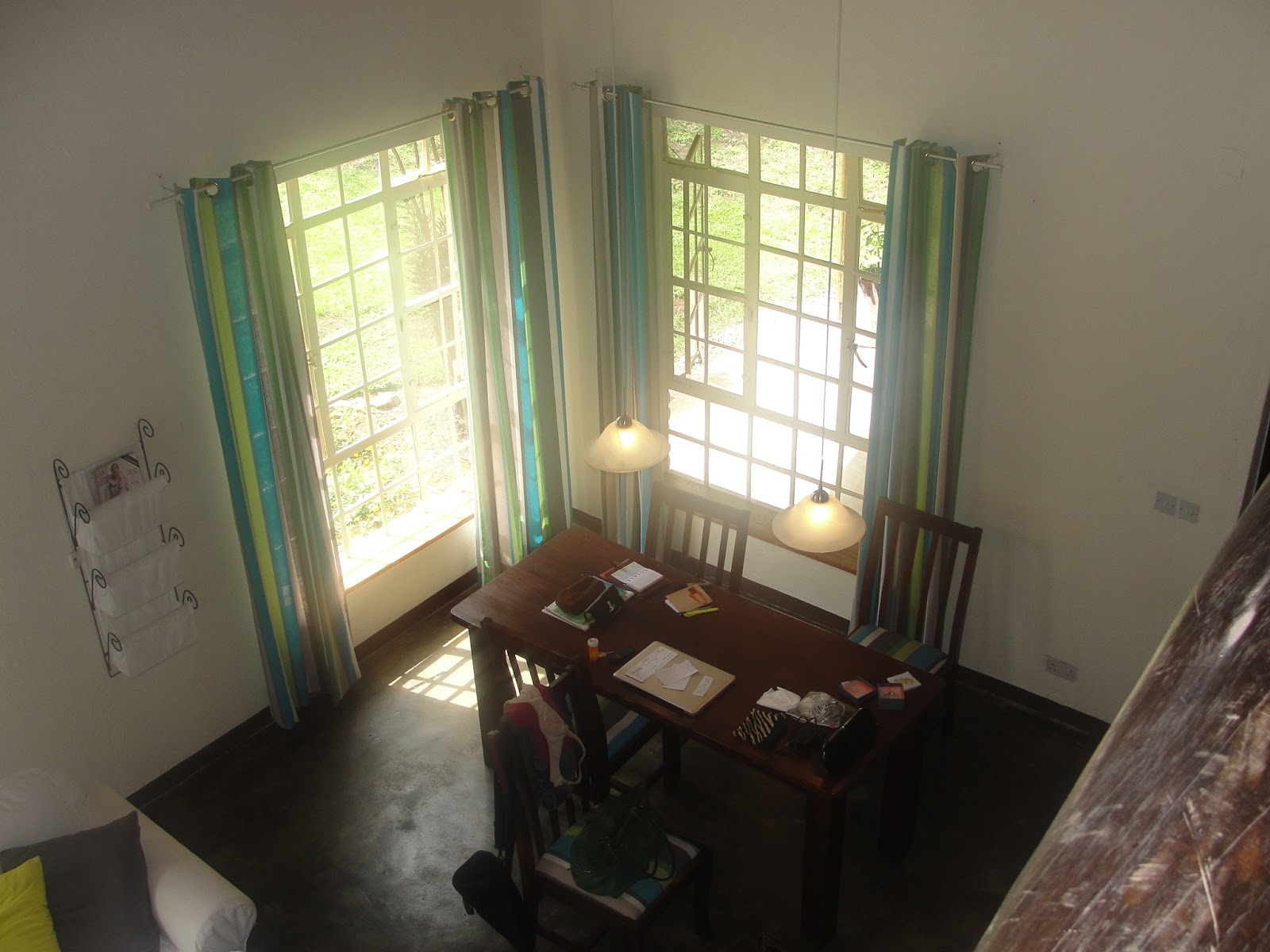
So, this blog entry is a tad bit late as I have been busy with various dribs and drabs, most notably moving house!!  Yes indeed, I am leaving the solace and sanctuary of Maji ya Chai and headed back to where it all began in Moshi.  This time around, I am NOT living in the center of town where every Tom, Dick, and Harry (Amani, Baraka, and Juma?) can find me, but rather in a quiet residential neighborhood.  Nonetheless, since Moshi is about the size of my high school biology class, I'll keep that data to myself as well.  At any rate, movin' out, but not necessarily up....Kwa heri Club Tee-Zed, and Mambo vipi Moshi!!

From my beautiful "Swiss ski chalet" in the middle of nowhere....


 ....To a pretty nice house in back in the Mo....


....But, of course, neither can compare to home sweet home in the N.Y.C....nyumbani ni nyumbani, si ndiyo?!

Saturday, March 16, 2013

Then and Now

One thing that has occurred to me upon my homecoming to Msaranga is just HOW LONG I have been in this country, and indeed this village in particular.  July of this year marks six years since I first set foot on African soil, and what was intended to be a brief interlude from my hectic life as a New York City publicist became....well....this!

It simply amazes me how my first group of nursery school kidlets has grown up (and how I have somehow managed not to age a day, hahaha) and flourished both physically and, it would seem, academically.

Check out the photos below of Msaranga totos past and present....


Lilian, smart as a whip back in the day, looks more like a mama now than I do.


Samson, always lived up to his biblical moniker, think he's in 5th grade, but his voice is deeper than my Dad's.


Tina, resembles my cat Beanie above, grown into those ears somewhat below.


Furaha, quiet, reflective, and sensitive as a child, seems to have remained that way as a young man.


Nicknamed "Brenda Mfupi" because she's a shorty-pants, she's still pretty tiny for her age.


As a nursery school kid, Flora couldn't write much except for mayai (eggs) which were meant to be either the letter "o."  Think she's gotten the hang of the other letters by now!


Ema M, my FAVORITE from day one!!  Love this child to bits, though not in a creepy Mary Kay Letourneau way.


Ema J went to a different nursery school but I taught him too and now the two Emas are best buds.  They often hang around outside the Standard One classroom waiting for me.  Per their request, and in my *spare* time (WHAT SPARE TIME, AM I INSANE??!!), we're starting an after-school English lesson next month for these two and twenty of the homies they roll with....Should be interesting!!


Saturday, March 9, 2013

Office Space

Well, it's not exactly "cubicle culture" and I doubt anyone will be answering the phone "Corporate Accounts Payable?" or going to Chotchkie's after work for pizza shooters, but it is an office.

Behold the brand-new kibao (signboard) for The Toa Nafasi Project headquarters in Moshi!!


Now, we just need some beige furniture, a water-cooler, and someone screaming about a paper jam in the printer and we'll be good to go!!

Sunday, March 3, 2013

Vumilia

Vumilia means patience in Swahili and it really is quite fitting that this is Vumi's full name.

Since I first met her and taught nursery school with her in July 2007, I have seen her as a constant source of comfort and compassion for the children of Msaranga as well as the best teacher I have come across in all of Kilimanjaro, Arusha, and the rest of the regions I have visited in Tanzania.  And she does it all without being sappy or sentimental; I really believe this is just her nature.

She can get a little mkali (strict) when she needs to; she'll use the stick or give a little pinch; she'll even tease or poke a little fun at a child....but it all works out in the end.  Though her teacher training was not great and her own primary and secondary school marks were pretty low, she just has that certain way about her that marks her as a true educator.  In part, it's her patience and in part it's her rather un-Tanzanian sense of totality and precision.  Like me, she simply can't let an error go, and we work well together.

You'll be hearing a lot more about Vumi in the next few months, so I just wanted to devote this post to her and say how much I enjoy working with her and how happy I am to have her as a friend and colleague.  Below, you can see her working with the MEMKWA student at Msaranga Primary School on his math lesson.  Check out the smile creeping up on his face in the last frame.  Breakthrough!!