With one week of vacay left to go, I am both savoring my last few days of freedom and gearing up for an exciting return to Msaranga. This month off from school has not been entirely work-free as you can see from my previous entries; I've had meetings galore and tons of computer work to catch up on. But I have always enjoyed my grassroots efforts the best, interacting with the kids in the class and the community at large.
So, while ruminating over my time at Msaranga Primary School since starting in February, I've been combing my camera for great photos that I've not yet posted. Check out a few of the best below.
I know I've remarked on it before but I just can't get enough of Mama T in all her cloaked glory.
Prosper is only three years old, but he comes to school with Vumi because his family are her next-door neighbors and she watches him during the day when they are working. I taught Prosper's sister Sia for two years in nursery school (she's now in Standard Four), so Prosper says my name is not "Sarah," but rather "Sia's Teacher."
I'm not sure who this little girl is, but just like me, she "hearts" New York!
This is Mary Stephano. I was playing around with the special effects on my camera and made the background black-and-white and kept her in color. Isn't it pretty?
Another special effects pic of the kids praying before eating makande. In the forefront, really giving the blessing his all, is Ian Brendan. (With a name like that, you'd think I was working in a school in Northern Ireland or something....)
The duara: schoolyard games played in a circle with songs and dances.
Tanzanians are crazy for soccer. If you're not a Man U super-fan, then you've got to be all about the Blues or crazy for the Gunners (big "whatever" from this American sports fan; think Yankees baseball or death) and even the kids love it. Anyhoo, we're thinking both the duara and "football" can be used Toa Nafasi-style to teach kids principles of cooperation and communication, and to get them active and engaged in non-scholastic activities.
Just two kids under a tree....
Just four kids in the bushes....
Mama T has started an after-school tutoring program for the kids in her class who either need extra help or whose parents want them to attend in lieu of hanging around the house the rest of the day. Predictably, it's a bit chaotic, but it's a step in the right direction.
Just wanted to give you a close-up on part of the frame above. Notice anything....amiss? Yes, that would be a homemade mini-machete that one of the kids brought to school and had sheathed in his waistband. The public school system in the South Bronx ain't got nuthin' on us!!
Graham Nash had it right when he sang of the ways in which grown people can influence the youth and the effects those stimuli can have, both positive and negative. It is clearly up to the watu wazima of Tanzania to teach their wadogo well....and Toa Nafasi is here to help.
This week's blog entry is dedicated to Angi whose summer fling in TZ is slowly winding down. She has about two more weeks in-country and then it's back to Boston with her and I'll remain here for another six weeks, then off to New York for the most dreaded part of running my own show: fundraising. (My most faithful readers are guaranteed to be on the receiving end of some whinging blog entries during the months of September, October, and November!!)
But though we'll be separated, Angi and I will still be doing the same work: figuring out how to introduce simple yet effective teaching interventions into the Tanzanian public school system so as to support the most vulnerable learners in the classroom. In this way, they will be able to better grasp the concepts presented in the standard Tanzanian syllabi and sit the same national examinations as their stronger cohorts. We also hope that for those students who present the most difficulties with academic work, we can find non-scholastic aptitudes within them to nurture and foster. Even basic life skills and vocational proficiencies have value in this community and showing others that people with disability can pull their own weight and take care of themselves is hugely important.
Similarly to me, Angi has been keeping a blog based on her professional work. You can find it here: http://blogs.umb.edu/angelastone/. Though we have different tones and writing styles, I think a lot of the subject matter overlaps and you might find it interesting to compare our two viewpoints of the same event.
In this case, rather than writing my own synopses of the events of the last couple of weeks since we have been on school vacation, I am going to shamelessly bite off Angi's. Here are her notes on (1) our meetings with Dr. Derrick Matthews, an American pediatrician working at Seliani Hospital in Arusha and Dr. Robin Peterson, a clinical psychologist, also working in Arusha, and (2) our sessions with Vumi where Angi introduced to us some new teaching methodologies we can use with the most troubled students we identified from the assessment; there are just under twenty who we will separate from the rest of the class for an hour or so each day and team-teach in cohorts of three.
####
(1) "This
week we went to several meetings with pediatricians and a clinical
psychologist. One of the interesting things that was discussed at the meetings
was the question, "Why do we need to know the cause or severity of the
disability?"
In the US, we want to know the cause of the disability and
to test using CAT scans and MRIs to look at neurological damage. I think wanting to know is important in many
cultures, but then after we know that a child will have an intellectual
disability, what do we gain from it?
Using medical and
psychological tests coupled with adaptive behavior scales and ruling out other
causes, we can somewhat determine that a child has an intellectual
disability. But then that information is used to label the child and develop
the Individualized Education Plan.
In Tanzania, it is expensive and unrealistic to do CAT scans
or MRIs, and we have already determined that the children we
are talking about are significantly behind their peers in the classroom, and that
the educational system they are experiencing is not working for them. Does
knowing or communicating a specific cause and term help these kids?
Knowing doesn’t
provide them access to a special classroom when that classroom doesn’t exist in
their school. It doesn’t change their situation.
Instead, it seems that trying
to find ways to support them with extra tutoring, giving them books to look at during the lesson, or making sure that they develop their adaptive
and vocational skills as well as academic is a better solution."
(2) "This week I have been working with Sarah and Vumi, teaching them
more about disability, behavior management, and intervention strategies for
teaching children with disabilities in the classroom.
When school starts again
in July, Vumi is going to work with various children who we
believe need extra help in a resource room model using various techniques and
materials/manipulatives we have discussed.
Today, we talked about functional
behavior assessment and various intervention techniques such as chaining, task
analysis, prompting, use of authentic activities, shaping and using models. We
are focusing on strategies to support reading, writing, and math instruction
first.
We also discussed the importance of adaptive skills and vocational
skills, but most of the children we are working with have learning disabilities,
so their adaptive skills are good, but they need support with academics.
After
some instruction yesterday, Vumi used a picture book as the basis to create
a lesson and I was very impressed. She did a great job. We brainstormed some
other days to add to her ideas and general concepts for improving the classroom
for all children."
And so I'll sing along with CSNY and we'll "feed them on our dreams." Polepole, The Toa Nafasi Project is getting there....
We are officially on holiday from school and Angi and I have been biding our time doing computer work at the Moshi version of Starbucks, camping out from morning til night, slurping Americanos like there's no more tomorrow. Aside from going through the data we collected from assessment and planning our curriculum modifications, I have been busy scouting fundraising possibilities, working on business banking, and getting back into web development - I cannot even BELIEVE the Toa Nafasi site is STILL not up, African time at its worst!! I hope to rectify that situation tout de suite!!
At any rate, I came across this article from The Gleaner out of Jamaica, West Indies, and being the "Jewmaican" that I am, it caught my eye. Check out the post below regarding a special education center in St. Andrew's parish, just north of Kingston.
####
The McCam Child Development Center, which provides for
children up to eight years old from gifted to slow learners, is now
planning some fund-raising activities to ensure that its doors remain
open. According to a member of the team at the center, Juliene
Campbell-Donaldson, the operational cost of the facility has been a
burden over the years.
"We have spent countless hours trying to
keep afloat," she noted, adding that its partnership with the government
and other entities has helped. Campbell-Donaldson
is hoping these partnerships will continue to facilitate the work of the
center which has been operating for almost 30 years.
The McCam
Child Development Center opened its doors in 1986 in response to the
demand for educational programming for children with a range of special
needs at the early-childhood level. The center has as its motto: 'It is no small thing to influence a child so fresh from the hands of God.'
The uniqueness of this institution for children is in the integration of the student population. Children with special needs work alongside gifted children without special needs. This allows for the acquisition of skills, as these children work and play together. Another
advantage of this system is the increased awareness and sensitivity it
brings to each other, particularly those with disabilities.
The
inclusive education program runs from nursery education to a preschool
program, which takes care of the requirements of the student
population, including those with special needs between the ages of six
months and six years.
In September 1987, under the umbrella of the center, a unit for the Total Development of Special Needs Children was established. It is a not-for-profit organization which focuses attention on those children with special needs in the program. The
unit is governed by a board of directors, and the center works in
collaboration with other agencies and government institutions to develop
and effectively implement early intervention services, and facilitates
the operation of and understanding of the various needs of these
children.
Children with disabilities now make up 40 percent of the population of the center's nursery and school program. Educational
and early childhood institutions and medical practitioners refer
children to the center for assessment and therapeutic interventions.
The
McCam Center serves the entire island, and has established itself as an
essential arm for both the disability sector (in special education) and
in early childhood education. Through therapeutic intervention,
the children are served by a team consisting of an occupational
therapist, a school psychologist, a clinical psychologist, a behavioral
specialist, and a special educator.
The center also conducts
workshops and seminars for teachers and parents, and provides practical
experience for students from various institutions. It also serves as a resource center for the dissemination of information on children with special needs.
The McCam curriculum was the first published early childhood curriculum in Jamaica and the Caribbean.
Aside from raindrops on roses and whiskers on kittens, I've discovered a few more of my favorite things as we've wrapped up this assessment phase of The Toa Nafasi Project. My very favorite thing is just how much we've accomplished in the short time Angi has been in Moshi and a close second is just how much of that has actually been gratifying and enjoyable.
We have examined 152 kids and ascertained that 19 of them need some sort of help outside of simple tuition after school. The potential problems we're seeing range the gamut from eyesight and hearing issues to turbulent home situations to intellectual impairment.
In order to confirm our hypotheses about these kids, we have undertaken the process of hojaji, a questionnaire for each of the 19 children we have concerns about, to be filled out by the teachers. That is now also pretty much done. Mama T looooved the whole thing by the way; she was completely in her element, filling the forms out aloud and with authoritative aplomb, licking the tip of her pen and stroking her beard.
Our next step is to interview the parents of these 19 kids with the same hojaji as we gave the teachers so we can compare the answers. We have basically finished this step as well with just a couple stragglers remaining for both sets of hojaji.
My third favorite thing has been how much we have been able to learn about these children from talking to the parents! We found that one child has had hearing issues since birth, something we would never have known without talking to her baba. We discovered that another child had yellow fever as an infant and may have some possible lingering maladies due to it. And in addition to the wealth of information we've been able to glean about the children's backgrounds is the fact that the parents have been utterly open and honest with us - it's amazing how quickly they responded to our calls to come to school, their willingness to be interviewed about their kids (a pretty personal subject, I should think) and even to have their talks recorded. Really, really gratifying work. Supa-fave.

Now, we are on holiday (also a favorite, btw) from school until the second week of July, so Angi and I are taking meetings with possible partners for the next phase: referral. Last week, it was Ruth Mlay at Comprehensive Community Based Rehabilitation Tanzania (CCBRT) and Sally Mohamedali and the team in the Special Education Needs Unit at The Jaffery Academy in Arusha. This week, it's Dr. Derrick Matthews, an American pediatrician at Arusha Lutheran Medical Centre (ALMC) and Robin Peterson at Arusha Mental Health Trust. We are hoping to be able to form some partnerships with other organizations in Kilimanjaro and Arusha in order to gain access to services for those children with medical/psychosocial problems outside of what Toa Nafasi can provide for.
In non-work-related-but-still-my-favorite-things news, we went to the house of my former student, Ema, a couple weeks ago to sit with his bibi and enjoy some of her delicious home cooking. Ever the gracious host, Ema had prepared the menu a good month and a half in advance based on, what else? My favorite things! So, we had rice, beans, avocado, and spinach. Bibi Ema, his younger sister Jesca (who I also taught), and several other rugrats showed up for the fiesta as well.


And in not-so-favorite-things news, here is one instance of when it is not-so-fun to be a mzungu in Africa as you have no clue as to what's going on, acts of "patriotism" seem mildly sinister, and fire is involved. The "mwenge torch" came to Msaranga the last week of May and shut down school for the morning as well as casting an uneasy cloud over me and Angi until we figured out WTH was going on. Apparently, it is an annual ritual that this blaze of fire gets carried around the country as a reminder of the original freedom torch lit up in the early years of Independence, a blaze that would, in Nyerere's words, "shine out beyond our borders, giving
hope where there was once despair, love where there was hate, and dignity
where, before, there was only humiliation." Unfortunately, all it really did this year, far as I can tell, is scare the bejeezus out of us two wazungu gals at Msaranga Primary School.

Finally, a small passing interchange that took place at school has stuck with me for the last couple weeks. It went a little something like this:
Sarah (somewhat pitiably): Everyone brings something to the table except me. Angi is the special education and early childhood development expert. Vumi is Tanzanian, a native Swahili speaker, and a teacher by profession. I can only do a little of both.
Angi (picking up the pieces): But without you, neither of us would be here doing this work.
Mama T (oblivious but spirited): IT IS REAL! GOD IS GOOD!!
I was going to write about the glorious denouement of our assessment phase this week (yes, we did indeed complete the whole darn thing in well under two weeks!!), but a recent visit of "inquiry" to Msaranga Primary School by three well-fed Tanzanian immigration officers prompted me to register myself on the website of the Embassy of the United States, Dar es Salaam, and I got sidetracked.
President Obama is coming to TZ! So far, we do not know his exact itinerary (so I can't genuinely confirm any dinner plans with him as yet), but we can guess Dar will be one confirmed stop and probably Arusha as well. Hopefully, he will make an appearance in Kilimanjaro at some point, but Moshi is often overlooked. I don't believe either Bill Clinton nor George W stopped here on their presidential visits....would be amazeballs if this POTUS could roll through and sort out some of the legalities of my expat status....
Check out below the "Statement by the Press Secretary on the President's Travel to Africa" as issued by the Embassy:
President Obama and the First Lady look forward to traveling to Senegal,
South Africa, and Tanzania from June 26 - July 3. The President will
reinforce the importance that the United States places on our deep and
growing ties with countries in sub-Saharan Africa, including through
expanding economic growth, investment, and trade; strengthening
democratic institutions; and investing in the next generation of African
leaders.
The President will meet with a wide array of leaders from government,
business, and civil society, including youth, to discuss our strategic
partnerships on bilateral and global issues. The trip will underscore
the President's commitment to broadening and deepening cooperation
between the United States and the people of sub-Saharan Africa to
advance regional and global peace and prosperity.
I also peeped this pic of the Ambassador, Alfonso E. Lenhardt, and find him to be a silver fox!! Maybe a return trip to Dar is in order? To introduce The Toa Nafasi Project, of course!
(More on the assessment and our future plans next week....)
Hello, friends! As promised, this blog entry is dedicated to the arrival of my friend and colleague, Angi Stone-MacDonald, and her work with Toa Nafasi.
Angi arrived in Moshi about a week ago and, after a not-so-restful weekend (setting up house, grocery shopping, helping me look for a new car, a road trip to Arusha, yada yada yada), she has finally settled back into life in TZ....I think.
I'm pretty sure I mentioned in a previous entry that Angi lived here for the year 2009, doing research for her dissertation in Lushoto (about 4-5 hours from Moshi in Tanga region) on developing curriculum for children with intellectual impairment in order that they learn life skills to be as self-sufficient adults as possible. A major part of her work was trimming the fat on the academic subjects being taught to mentally challenged students and focusing on the "community funds of knowledge" whereby they received instruction in areas they actually needed to know, such as math for money value, or reading for boarding a bus.
At any rate, she is now back after four years in the U.S. (during which time she became an Assistant Professor at the University of Massachusetts, Boston, in Early Education and Care in Inclusive Settings) and on board with Toa Nafasi in a consultancy capacity. The situation is ideal and mutually beneficial: for me, to help assess my kids in Msaranga, and for her, to inform further research on schoolchildren with disabilities in Tanzania.
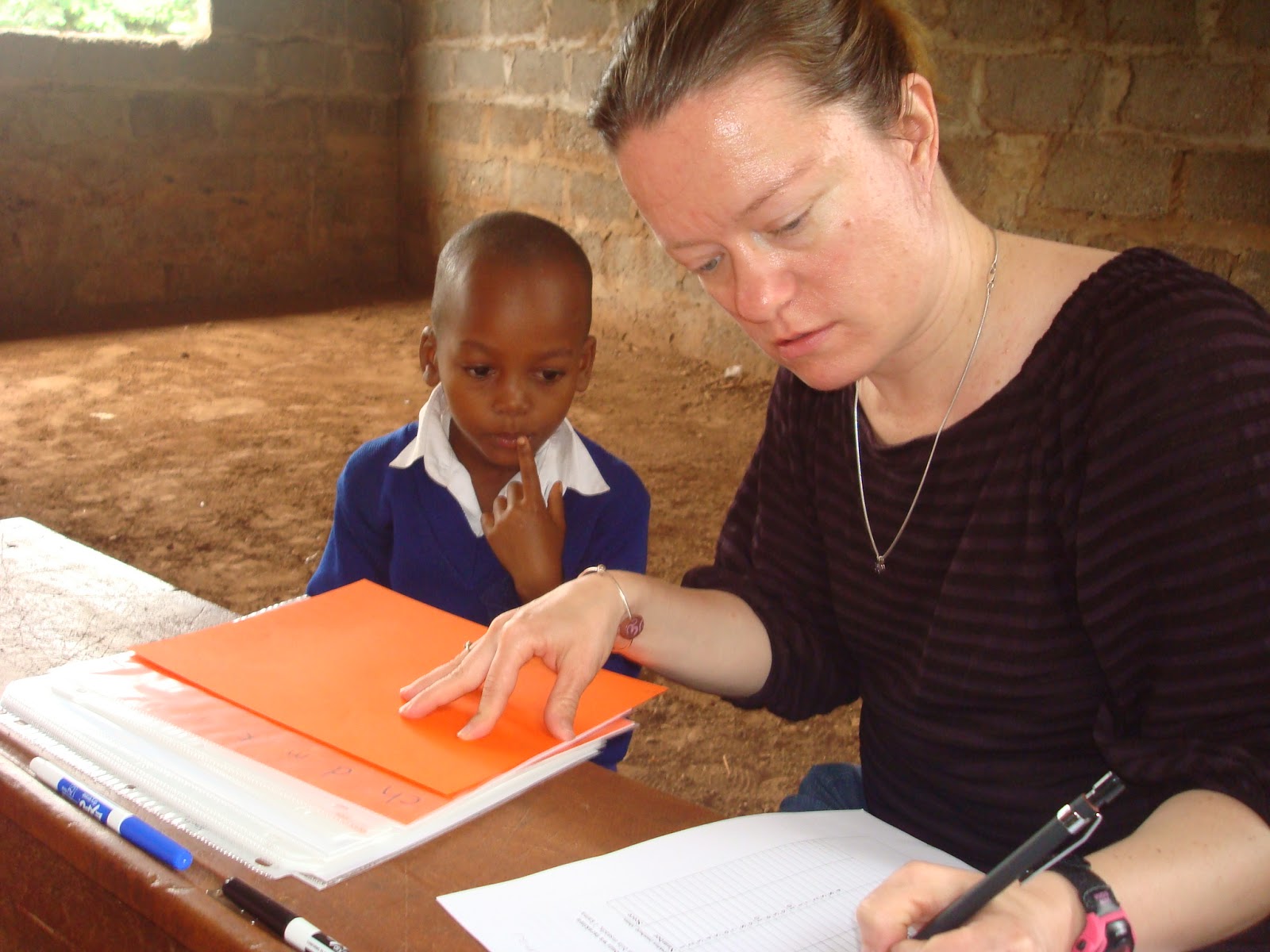
On Monday, Angi came to Msaranga Primary School for the first time and met Mama T and Dada M as well as Vumi. She also had the chance to introduce herself to the kids and get to know a couple of them and look at their work.
Then, we began our work on the assessment the next day with a tutorial from Angi for me and Vumi on the various components of the test and how to execute it. The assessment is comprised of a bunch of different sections designed to examine cognitive skills (literacy and numeracy), gross and fine motor skills, and social and adaptive skills.
Vumi and I watched Angi with one of our brightest (and youngest at only 5 years old!!) pupils, and tried to learn from her example.
Then Vumi and I each had a trial run with students of our own while Angi watched and gave us pointers on what was good and what we should change about our approach.


That first day, we got through only five complete assessments - slow because of us newbies, and a small source of worry for Angi who thought maybe we wouldn't be able to get through our nearly 160 Standard One schoolchildren during the two months she will be here, one of which the school will be out for "summer" vacation. Fortunately for all of us however, Vumi and I are quick studies and the next day, we collectively got through 28 tests and the following day, 32. I'm guessing if we continue at this clip, we'll be done by the middle of next week and then able to analyze the data and start making our plans for referrals and curriculum modification. Already, we have seen students that we want to test for poor vision, color-blindness, speech therapy, dyslexia, Marfan syndrome, and anencephaly. Others Angi has identified as having mild intellectual disabilities or simply needing extra help outside the classroom to catch up. Though the work is hard and in the past three days I have already run the gamut of emotion from a.) near tears, b.) steaming mad, c.) sick and tired, and d.) exultant, I feel as though I am doing something really important and worthwhile. Plus, Angi, Vumi, and I make a threesome on par with a special ed Charlie's Angels tag team!
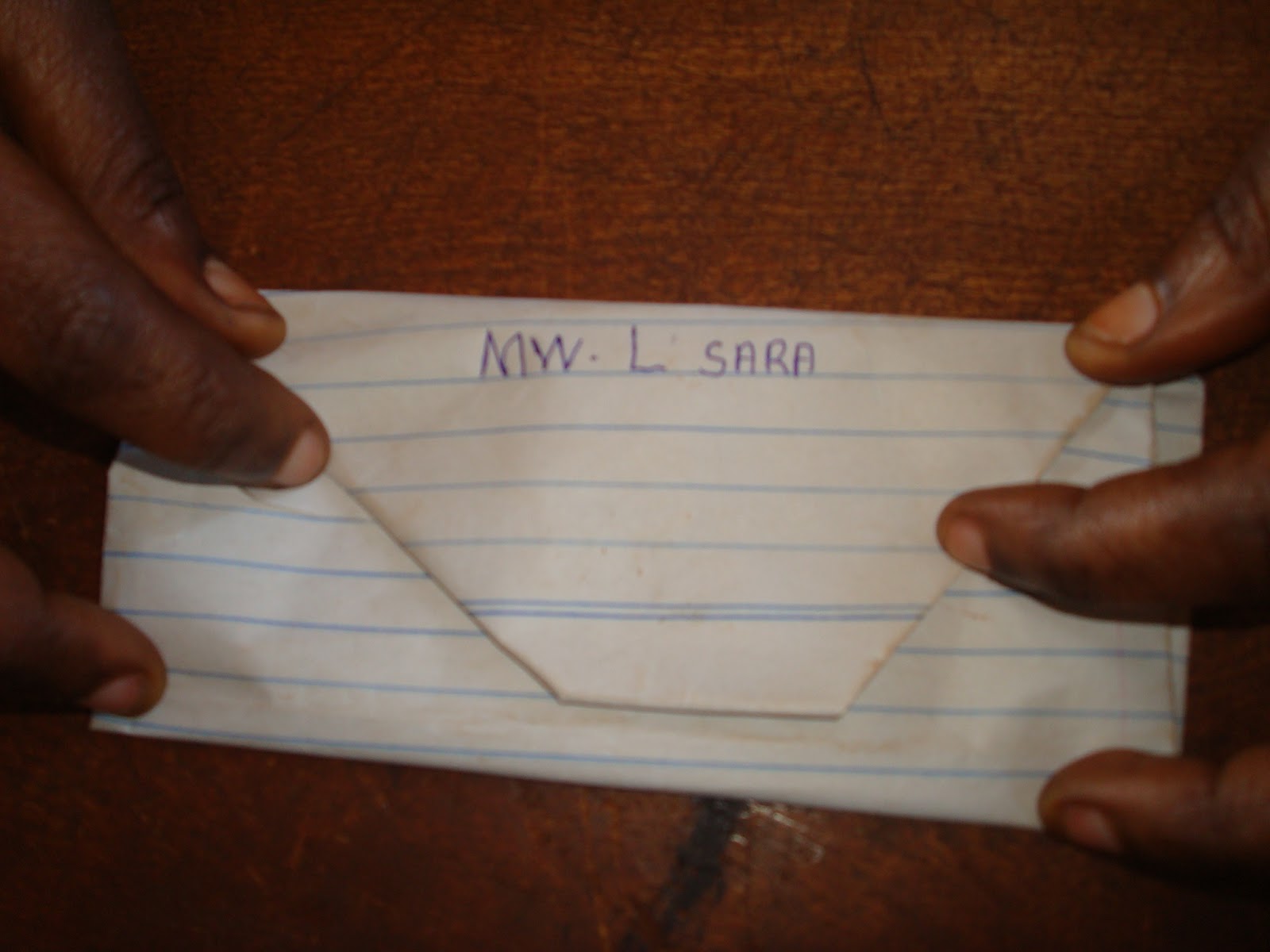
The only problem is that now with this assessment in full gear, I have been neglecting my little boyfriend Ema from Standard 5!! He waits by the classroom door for me everyday but I don't take breaks long enough to chat with him and by the end of the day, I am exhausted and dirty and just want to go home. Poor thing actually issued me this letter via paper airplane trying to get my attention.
At any rate, Toa Nafasi is now going gangbusters and I am very happy if a bit fatigued. Stay tuned for more from next week's entry!
Well, it took two and a half months, but the sign at the Toa Nafasi office in Moshi is finally hung! We had a spot of shida getting the proper implements as well as a person to implement them - as Baba Ngowi would sum up, "This is the problem with fundis" - but the job is now done and we have our Tanzanian headquarters in place.
The great thing about our office is that Baba is also acting as an M-Pesa agent, so you can come into Toa Nafasi, learn more about kids with special needs, AND send money to your broke auntie in Morogoro. Good times.